International Journal of Communication Publishes a Special Section on Global Populism: Its Roots in Media and Religion

International Journal of Communication Publishes a Special Section on
Global Populism: Its Roots in Media and Religion

“Fascism Worship” by Johnnie Silvercloud (CC BY-NC 2.0)

If we were to use one word to describe the recent trend in global politics, populism would no doubt be a strong candidate. From Donald Trump to Jair Bolsanaro and from Narendra Modi to Giorgia Meloni, right-wing populist movements have upended assumptions about contemporary politics and have seeded concerns about the future of liberal democracies across the globe.  

This Special Section on Global Populism: Its Roots in Media and Religion, guest-edited by Johanna Sumiala, Stewart M. Hoover, and Corrina Laughlin, advances scholarly understanding of the present dynamics of global politics in the hybrid media environment. While emergent populist movements increasingly use symbols and tropes in their political communication, religion and “the religious” tend to be ignored or acknowledged only at the most superficial level in the present research in media and communication studies. 

The articles in this Special Section attempt to fill in this gap in scholarship and address populism, media, and religion in a variety of media, political, and cultural contexts ranging from Finland, Norway, Poland, Italy, Turkey to India, Brazil, and the United States. Expert authors from media and communication studies, political science, and religious studies address political and religious populism with a special focus on nationalist and right-wing movements. The authors apply conceptual frameworks such as “religious populism,” gender, nationalism, fundamentalism, “civilizationism,” Islamophobia, and victimhood to study religion and populism in diverse media contexts ranging from newspapers to Twitter. In the afterword, John L. Jackson, Jr. reminds media and communication scholars to keep race in mind as they analyze religious and populist phenomena in the present political moment. 

We invite you to read these articles that published in the International Journal of Communication on April 4, 2023. Please log into ijoc.org to read the papers of interest. We look forward to your feedback! 
____________________________________________________________________________________

Religious Populism? Rethinking Concepts and Consequences in a Hybrid Media Age—Introduction
Johanna Sumiala, Stewart M. Hoover, Corrina Laughlin

The World Congress of Families: Anti-Gender Christianity and Digital Far-Right Populism 
Giulia Evolvi

The Role of Religion in Construction of the People and the Others: A Study of Populist Discourse in the Polish Media
Agnieszka Stępińska  

“Brazil Above Everything. God Above Everyone.” Political-Religious Fundamentalist Expressions in Digital Media in Times of Ultra-Right Nationalism in Brazil
Magali do Nascimento Cunha

Islam as the Folk Devil: Hashtag Publics and the Fabrication of Civilizationism in a Post-Terror Populist Moment
Johanna Sumiala, Anu A. Harju, Emilia Palonen

Triggers and Tropes: The Affective Manufacturing of Online Islamophobia 
Mona Abdel-Fadil

Mediating Muslim Victimhood: An Analysis of Religion and Populism in International Communication 
Bilge Yesil

Populism, Religion, and the Media in India 
Pradip Ninan Thomas

The Ghosts in the Machine of Contemporary Scholarship on Media and Communication—Afterword
John L. Jackson, Jr.

____________________________________________________________________________________
Larry Gross, Editor 
Kady Bell-Garcia, Managing Editor
Chi Zhang, Managing Editor, Special Sections
Johanna Sumiala, Stewart M. Hoover, and Corrina Laughlin, Guest Editors

Please note that according to the latest Google Scholar statistics, IJoC ranks 9th among all Humanities journals and 9th among all Communications journals in the world — demonstrating the viability of open access scholarly publication at the highest level.
International Journal of Communication announces the publication of 40 papers that published in March

International Journal of Communication invites you to read these 40 papers that published in March

The International Journal of Communication is pleased to announce the publication of 40 papers in MARCH 2023, which includes the “Special Section on Digital Memory and Populism” and the “Special Section on Queer Cultures in Digital Asia.” To access these papers, Ctrl+Click on the titles below for direct hyperlinking or go to ijoc.org to read the Special Sections.
_______________________________________________________________________

ARTICLES

Is Ubiquitous a Good Thing? The Vulnerability of Using Smartphones Among Seniors in Taiwan
Luc Chia-Shin Lin  

A Survey of U.S. Science Journalists’ Knowledge and Opinions of Open Access Research
Teresa Schultz  

Express Yourself? Political Conversation, Emotion Regulation, and the Expression of Political Emotions
Christina M. Henry, William P. Eveland, Jr.  

Chinese LGBTQ+ Online Social Movements: A Comparative Study Between the Collective Identity Framings in the #IAmGay and #IAmLes Protests
Xing Huang

“Influencers” or “Doctors”? Physicians’ Presentation of Self in YouTube and Facebook Videos
Noha Atef, Alice Fleerackers, Juan Pablo Alperin  

Media Use and Political Trust in Kenya: Media Malaise or Virtuous Circle?
Gilbert Kipkoech

Predicting Romantic Comedy Success From Content
Melissa M. Moore, Yotam Ophir

Microaggression Terminology in Communications on Twitter: A Corpus Linguistic Analysis
Iain Alexander Smith, Amanda Griffiths, Kevin Harvey  

Changing Narratives: An Evaluation of Pakistan’s Public Diplomacy Efforts Under Imran Khan
Ravale Mohydin

Platformization in Local Cultural Production: Korean Platform Companies and the K-Pop Industry
Seoyeon Park, Hyejin Jo, Taeyoung Kim

Does Relational Polarization Entail Ideological Polarization? The Case of the 2017 Norwegian Election Campaign on Twitter
Bernard Enjolras

Immigrant Characters in Spanish Audiovisual Broadcast on Platforms
María Marcos-Ramos, Ariadna Angulo-Brunet, Beatriz González-de-Garay

The Great Reset and the Cultural Boundaries of Conspiracy Theory
Michael Christensen, Ashli Au

Seeking Online Health Information for Aged Parents in China: A Multigroup Comparison of the Comprehensive Model of Information Seeking Based on eHealth Literacy Levels
Xin Ma, Liang Chen

Imagined Audiences and Activist Orientations of Migrant Advocacy Organizations
Sara DeTurk

Reconsidering Misinformation in WhatsApp Groups: Informational and Social Predictors of Risk Perceptions and Corrections
Ozan Kuru, Scott W. Campbell, Joseph B. Bayer, Lemi Baruh, Richard S. Ling

Far Removed From Heteronormativity: Marriage and Same-Sex Couples in a Spanish TV News Program (2011–2020)
Adolfo Carratalá

The Development of Local News Collaboration: A Population Ecology Perspective
Wilson Lowrey, Nicholas R. Buzzelli, Ryan Broussard


BOOK REVIEWS

Rebecca Wanzo, The Content of Our Caricature: African American Comic Art and Political Belonging
Florence Zivaishe Madenga 

Daniel E. Agbiboa, Mobility, Mobilization, and Counter/Insurgency: The Routes of Terror in an African Context
Buket Oztas

Mike Hill, On Posthuman War: Computation and Military Violence
Maia Nichols

T. Bettina Cornwell and Helen Katz, Influencer: The Science Behind Swaying Others
Hannah Block

Shayda Kafai, Crip Kinship: The Disability Justice & Art Activism of Sins Invalid
Jaggar DeMarco

Balsam Mustafa, ‘Islamic State’ in Translation: Four Atrocities, Multiple Narratives
Jared Ahmad

Hermann Wasserman and Dani Madrid-Morales (Eds.), Disinformation in the Global South
Noah Zweig

C. Simon Fan, The Socioeconomics of Nationalism in China: Historical and Contemporary Perspectives
Wenliang Chen

______________________________________________________________________
Larry Gross, Editor
Kady Bell-Garcia, Managing Editor
Chi Zhang, Managing Editor, Special Sections


Please note that according to the latest Google Scholar statistics, IJoC ranks 9th among all Humanities journals and 9th among all Communications journals in the world — demonstrating the viability of open access scholarly publication at the highest level.

International Journal of Communication Publishes a Special Section on Queer Cultures in Digital Asia

International Journal of Communication Publishes a Special Section on
Queer Cultures in Digital Asia

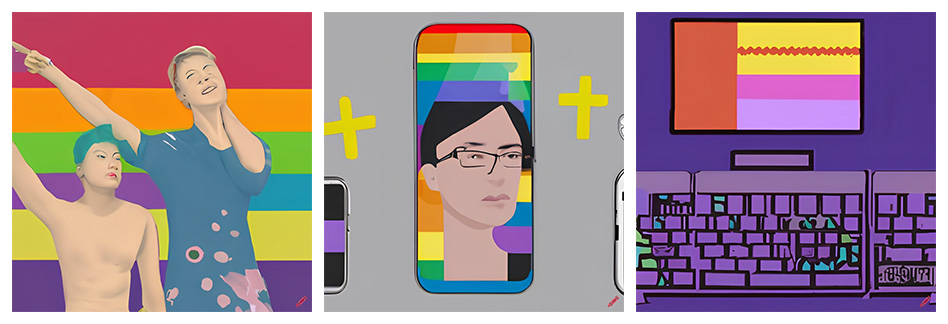
 Image created by Lik Sam Chan with Craiyon, an artificial intelligence art generator. 

What are the challenges and opportunities offered to queer communities and practices by social media and digital platforms such as Twitter, Instagram, Weibo, Grindr, Blued, Butterfly, and more, in the context of Asia? 

Inspired by Mobile Cultures: New Media in Queer Asia (Berry, Martin, Yue, & Spigel, 2003), published in 2003, and the subsequent two decades of critical scholarship on Queer Asia, this Special Section on Queer Cultures in Digital Asia aims to renew our critical interrogation of the intersection between queerness and Asia at a time when digital media and platforms are inseparable from social lives. Asia provides a complicated context for the development and survival of queer communities as social norms and laws regarding same-sex relationships and gender transition vary across regions. 

Guest-edited by Lik Sam Chan, Jia Tan, and Elija Cassidy, this Special Section examines how contemporary queer lives are platformized, investigating an array of issues from amateur gay porn cultures, lesbian and gay dating apps, trans men’s self-representation, to Boys’ Love fandom, as well as how these are mediated through specific digital platforms. 

While platformed digital media undoubtedly offers new opportunities for queer communities and practices, community-based regulations and internal stratification and discrimination also close off certain forms of queer expression and queer potential. Contributors to this Special Section offer empirical analyses of queer digital cultures, platforms, practices, and communities from one or multiple Asian regions. They highlight how regional specificity has contributed to the manifestation of queer practices and cultures. With new digital phenomena emerging—live streaming, games, robots and AI, non-fungible tokens, health tracking—and social and legal environments evolving, Queer Cultures in Digital Asia will always be in a state of flux. This Special Section can hopefully open further conversations about digital media and queerness among scholars working across a range of diverse Asian contexts. 

We invite you to read these articles that published in the International Journal of Communication on March 19, 2023. Please log into ijoc.org to read the papers of interest. We look forward to your feedback! 

____________________________________________________________________________________

Queer Cultures in Digital Asia—Introduction
Lik Sam Chan, Jia Tan, Elija Cassidy

Digital Sexual Publics: Understanding Do-It-Yourself Gay Porn and Lived Experiences of Sexuality in China
Runze Ding, Lin Song

Attention Economy, Neoliberalism, and Homonormative Masculinity in Amateur Gay Porn Circuits on Twitter: The Case of Manila and Hong Kong
Ruepert Jiel Dionisio Cao 

“I Look at How They Write Their Bio and I Judge From There”: Language and Class Among Middle-Class Queer Filipino Digital Socialities in Manila 
Paul Michael Leonardo Atienza

Strategic, Conflicted, and Interpellated: Hong Kong and Chinese Queer Women’s Use of Identity Labels on Lesbian Dating Apps 
Carman K. M. Fung

Tracing Dystopian Insta-Emotions Among Hong Kong Trans Men 
Denise Tse-Shang Tang 

Participatory Censorship and Digital Queer Fandom: The Commercialization of Boys’ Love Culture in China
Yiming Wang, Jia Tan 

____________________________________________________________________________________
Larry Gross, Editor 
Kady Bell-Garcia, Managing Editor
Chi Zhang, Managing Editor, Special Sections
Lik Sam Chan, Jia Tan, and Elija Cassidy, Guest Editors

Please note that according to the latest Google Scholar statistics, IJoC ranks 9th among all Humanities journals and 9th among all Communications journals in the world — demonstrating the viability of open access scholarly publication at the highest level.

International Journal of Communication Publishes a Special Section on Digital Memory and Populism

International Journal of Communication Publishes a Special Section on
Digital Memory and Populism

Screenshot of the photo “Populism Paste-up, Berlin” by Dr Case (CC BY-NC 2.0).

In a world of flux, the past can become a guiding beacon; yet, in which direction do populists move and how do counter-voices mobilize memory online to respond to often divisive interpretations of the past?  

Guest-edited by Manuel Menke and Berber Hagedoorn, this Special Section on Digital Memory and Populism presents work by international academic researchers who shed light on the uses of the past by populists, their supporters, and their opponents in online discourses. Readers will gain a better understanding of digital memory and populism in the realm of party politics and beyond, since populist communication and narratives have entered civil society and people’s everyday lives in many democracies across the world. 

In seven articles, the authors contribute unique insights into how digital memory is shared, represented, constructed, and exploited to promote or tackle populism in Germany, Japan, Mexico, Turkey, and the United States. Together, the articles in this Special Section exhibit digital memory as an important analytical lens to understand populism and its uses of the past from a media and communication perspective. The presented studies feature different conceptual and empirical approaches demonstrating how contested and therefore powerful memory is in populism, shaping digital discourses on identity, belonging, and political ideology. Some articles, however, also emphasize the potential of digital memory to organize and mobilize bottom-up voices countering populist narratives by the means of digital media, networked communication, and activism. Thereby, the research articles in this Section contribute new pieces to the puzzle of populism’s success, while also highlighting possible counter-narratives.

We invite you to read these articles that published in the International Journal of Communication on March 2, 2023. Please log into ijoc.org to read the papers of interest. We look forward to your feedback! 
____________________________________________________________________________________

Digital Memory and Populism—Introduction
Manuel Menke, Berber Hagedoorn

Populists’ Use of Nostalgia: A Supervised Machine Learning Approach
Lena Frischlich, Lena Clever, Tim Wulf, Tim Wildschut, Constantine Sedikides 

Commemorative Populism in the COVID-19 Pandemic: The Strategic (Ab)use of Memory in Anti-Corona Protest Communication on Telegram 
Christian Schwarzenegger, Anna Wagner  

Radical-Right Populist Media Discourse in Social Media and Counter Strategies: Case Study of #ConfederateHeritageMonth 2021 Twitter Campaign
Krzysztof Wasilewski

Deploying Private Memory in the Virtual Sphere: Feminist Activism Against Gender-Based Violence in Mexico 
Emanuela Buscemi

Remembering Gezi: The Digital Memory Practices on Twitter During the Anniversaries in the Face of Populist Challenges
Duygu Karataş, Mine Gencel Bek

Remembering and Forgetting Fukushima: Where Citizen Science Meets Populism in Japan 
Yasuhito Abe

____________________________________________________________________________________
Larry Gross, Editor 
Kady Bell-Garcia, Managing Editor
Chi Zhang, Managing Editor, Special Sections
Manuel Menke and Berber Hagedoorn, Guest Editors

Please note that according to the latest Google Scholar statistics, IJoC ranks 9th among all Humanities journals and 9th among all Communications journals in the world — demonstrating the viability of open access scholarly publication at the highest level.

International Journal of Communication invites you to read these 49 papers that published in February

International Journal of Communication invites you to read these 49 papers that published in February

The International Journal of Communication is pleased to announce the publication of 49 papers in FEBRUARY 2023, which includes the “Special Section on Encounters Between Violence and Media” and the “Special Section on Media Use and Political Engagement: Cross-Cultural Approaches.” To access these papers, Ctrl+Click on the titles below for direct hyperlinking or go to ijoc.org to read the Special Sections.
_______________________________________________________________________

ARTICLES

#TrendingNow: How Twitter Trends Impact Social and Personal Agendas?
Maggie Mengqing Zhang, Yee Man Margaret Ng 

Perceived Exposure to Misinformation and Trust in Institutions in Four Countries Before and During a Pandemic
Shelley Boulianne, Edda Humprecht 

A Cross-Country Study of Comparative Optimism About Privacy Risks on Social Media
Hichang Cho, Miriam Metzger, Sabine Trepte, Elmie Nekmat  

Media Representations of Nüding in China (2005–2015)
Chao Lu, Ke Zhang, Jingyuan Zhang  

Visual Models for Social Media Image Analysis: Groupings, Engagement, Trends, and Rankings
Gabriele Colombo, Liliana Bounegru, Jonathan Gray  

Comparing the Effects of Traditional Media and Social Media Use on General Trust in China During the COVID-19 Pandemic
Mengru Sun, Xiang Meng, Wencai Hu 

Fans’ Practice of Reporting: A Study of the Structure of Data Fan Labor on Chinese Social Media
Haoyang Zhai, Wilfred Yang Wang 

“I Have Learnt These Things by Myself, Because I Always Thought That I Must Overcompensate for My Disability”: Learning to Perform Dis/abled Identity in Social Media
Nomy Bitman

Digital Patronage: Toward a New Model of Building a Radio Station
Patryk Galuszka, Piotr Chmielewski

Governmentality in North American and Post-Soviet Political Discourses: An Analysis of Presidential Speeches and Their Analogues in the United States, Canada, Russia, Ukraine, and Kazakhstan Delivered From 1993 to 2021
Anton Oleinik 

When Right-Wing Populism Becomes Distorted Public Health Communication: Tracing the Roots of Jair Bolsonaro’s Epidemiological Denialism
Stuart Davis, João V. S. Ozawa, Joseph Straubhaar, Samuel Woolley 

10,000 Social Media Users Can(not) Be Wrong: The Effects of Popularity Cues and User Comments on Sharing Controversial Social Media News Stories
Arjen van Dalen 

Online Pre-Events During the COVID-19 Pandemic 
Luigi Di Martino, Lukasz Swiatek

“We’re Not Just Telling Stories, We’re Changing Lives”: Dhar Mann’s Progressive Neoliberalism
Sean T. Leavey 

Contact-Tracing Apps as Boundary Objects of Pandemic Governance: The State-by-State Approach to Contain the Spread of COVID-19 in the United States
Eugene Jang, Jeeyun (Sophia) Baik, Katrin Fischer

A Transactional Framework of Parenting for Children’s Internet Use: A Narrative Review of Parental Self-Efficacy, Mediation, and Awareness of Online Risks
Seffetullah Kuldas, Aikaterini Sargioti, James O’Higgins Norman, Elisabeth Staksrud 

The Linguistic and Message Features Driving Information Diffusion on Twitter: The Case of #RevolutionNow in Nigeria
Oluwabusayo Okunloye, Kerk F. Kee, R. Glenn Cummins, Weiwu Zhang 

Two Trusts and a Court: Adapting Legal Mechanisms for Building Trust in Technology Governance
Opeyemi Akanbi, Stephanie Hill 

Do Not Use This Hashtag: Fat Acceptance (Mis)information and Discursive Boundary-Work as Content Moderation on Instagram
Melissa Zimdars 

Race, Class, and Sonic Autonomy in the Tower Blocks: Pirate Radio’s Exilic Possibilities
Larisa Kingston Mann 

Political Relational Influencers: The Mobilization of Social Media Influencers in the Political Arena 
Anastasia Goodwin, Katie Joseff, Martin J. Riedl, Josephine Lukito, Samuel Woolley 

Changing Mass Media Consumption Patterns Before/After Relocation: East Asian International Students’ Mass Media Use and Acculturation Strategies
Lin Li, Chengyuan Shao 

Temporal Citizen Science After Fukushima
Yasuhito Abe 

Managing Pandemic Communication Online: Turkish Ministry of Health’s Digital Communication Strategies During COVID-19
Emel Ozdora Aksak, Ergin Şafak Dikmen, Nilüfer Pinar Kiliç


FEATURES

A Discussion of Think Tanks in Climate Obstruction in Response to the “Analysis of the Moreno et al. (2022) Publication on EIKE Using Peter Gleick’s Toolbox”
Jose A. Moreno, Mira Kinn, Marta Narberhaus 

Analysis of the Moreno et al. (2022) Publication on EIKE Using Peter Gleick’s Toolbox 
Horst-Joachim Lüdecke 


BOOK REVIEWS

Kylie Jarrett, Digital Labor
Micky Lee 

Francesca Bolla Tripodi, The Propagandists’ Playbook: How Conservative Elites Manipulate Search and Threaten Democracy
Jose Mari Hall Lanuza

Renyi Hong, Passionate Work: Endurance After the Good Life
Thomas A. Discenna 

Kelli Moore, Legal Spectatorship: Slavery and the Visual Culture of Domestic Violence
Ke M. Huang-Isherwood 

Jonathan Rauch, The Constitution of Knowledge: A Defense of Truth 
Sue Curry Jansen 

D. Bondy Valdovinos Kaye, Jing Zeng, and Patrik Wikström, TikTok: Creativity and Culture in Short Video
Parker Bach 

Páraic Kerrigan, LGBTQ Visibility, Media and Sexuality in Ireland
Aiden James Kosciesza 

Christian Vaccari and Augusto Valeriani, Outside the Bubble: Social Media and Political Participation in Western Democracies
João Carlos Sousa

______________________________________________________________________
Larry Gross, Editor
Kady Bell-Garcia, Managing Editor
Chi Zhang, Managing Editor, Special Sections

Please note that according to the latest Google Scholar statistics, IJoC ranks 9th among all Humanities journals and 9th among all Communications journals in the world — demonstrating the viability of open access scholarly publication at the highest level.