International Journal of Communication Publishes a Forum on Groundhog Day

International Journal of Communication Publishes a Forum on Groundhog Day


The latest International Journal of Communication Forum collection Groundhog Day, guest edited by Crystal Abidin, is based on a one-day online-only open-access collection of roundtables recently hosted by the Influencer Ethnography Research Lab at Curtin University, Australia. Contributors focused on the cyclical nature of academic spotlights and hot topics in the field of Internet studies, and some of the frustrations related to the ahistoricity of the discussions and moral panics across some scholarship, the media, and public discourse. Over four panels, this event addressed the cycles, patterns, templates, and related fatigue on digital media discourse. Collectively, our articles draw on empirical research to address and challenge some popular and oft-regurgitated conceptions about uses of digital media: Are influencers just vain? Is digital media fake and does it teach young people the wrong things about sexuality? Does the Internet destroy and save our mental health? Are memes new? 

Contributors include Crystal Abidin (Curtin University), Srikanth Nayaka (GITAM & Indian Institute of Technology Tirupati), Earvin Charles B. Cabalquinto (Monash University), Jia Guo (Curtin University & University of Sydney), Kath Albury (Swinburne University of Technology), Samantha Mannix (Swinburne University of Technology), Barrie Shannon (University of South Australia), Hao Zheng (Curtin University), Natalie Ann Hendry (University of Melbourne), Natasha Zeng (Monash University), Tom Short (RMIT), Clare Southerton (La Trobe University), Gabriele de Seta (University of Bergen), Idil Galip (University of Amsterdam), Lucie Chateau (Tilburg University), and Günseli Yalcinkaya (Dazed).

We invite you to read these articles that published in the International Journal of Communication on January 6, 2025. Please log into ijoc.org to read the papers of interest. We look forward to your feedback! 

____________________________________________________________________________________

Influencers Are Just Vain
Crystal Abidin, Srikanth Nayaka, Earvin Charles B. Cabalquinto, Jia Guo 

Digital Media Is Fake and Teaches Young People the Wrong Things About Sexuality
Kath Albury, Samantha Mannix, Barrie Shannon, Hao Zheng

The Internet Destroys and Saves Our Mental Health
Natalie Ann Hendry, Tom Short, Clare Southerton, Natasha Zeng

Memes Are New
Gabriele de Seta, Idil Galip, Lucie Chateau, Günseli Yalcinkaya

___________________________________________________________________________________
Silvio Waisbord, Editor 
Kady Bell-Garcia, Managing Editor
Chi Zhang, Managing Editor, Special Sections
Crystal Abidin, Guest Editor

Please note that according to the latest Google Scholar statistics, IJoC ranks 7th among all Humanities journals and 9th among all Communications journals in the world — demonstrating the viability of open access scholarly publication at the highest level.
International Journal of Communication invites you to read these 35 publications that published in November

International Journal of Communication invites you to read these 35 publications that published in November

The International Journal of Communication is pleased to announce the publication of 35 papers in NOVEMBER 2024, which includes the “Special Section on The Ultra-Right: Media, Discourses, and Communicative Strategies.” To access these papers, Ctrl+Click on the titles below for direct hyperlinking, or go to ijoc.org.

_______________________________________________________________________

ARTICLES

Populism Fuels Hate Speech and Disinformation: Evidence From Political Discourse on X (Formerly Twitter) in India and Pakistan
Shabir Hussain, Qamar Abbas, Sayyed Fawad Ali Shah

Ghost in Dissent: Artifacts and the Architecture of Activism in Digital China
Mengyang Zhao, Anosartor

Racism in the Platformized Cultural Industries: Precarity, Visibility, and Harassment in Canada
Daniela Zuzunaga Zegarra

Exposure to Online Hateful Content and Users’ Engagement: A Silencing Effect
Nicoleta Corbu, Raluca Buturoiu, Oana Ștefăniță, Alexandru Dumitrache

Can This Platform Survive? Governance Challenges for the Fediverse
Thomas Struett, Aram Sinnreich, Patricia Aufderheide, Robert W. Gehl

OK, Boomer: Activating Intergroup Perceptions to Facilitate Intergenerational Contact in Social Media
Alexandra S. Hinck, Caleb T. Carr

“Woman, Life, Freedom”: A Visual Rhetoric Analysis of #MahsaAmini on X
Menna Elhosary, Laila Abbas, Shahira S. Fahmy

Watching Grey’s Anatomy as Sexual Assault Prevention? Examining Factors Related to College Students’ Attitudes and Intended Behaviors
Valerie Ellen Kretz, Anna Marie VanSeveren

Divisive, Negative, and Populist?! An Empirical Analysis of European Populist and Mainstream Parties’ Use of Digital Political Advertisements
Simon Kruschinski, Márton Bene, Jörg Haßler, Uta Rußmann, Darren Lilleker, Delia Cristina Balaban, Paweł Baranowski, Andrea Ceron, Vicente Fenoll, Daniel Jackson

Playing With Visibility: Underground Electronic/Dance Music Culture in the Smartphone Era
Stephen Yang

In/Visibility in the Digital Age: A Literature Review From a Communication Studies Perspective
Helena Stehle, Annekatrin Bock, Claudia Wilhelm, Nina Springer, Merja Mahrt, Katharina Lobinger, Christine Linke, Ines Engelmann, Hanne Detel, Cornelia Brantner

Cross-Cultural TV Drama Viewing, Parasocial Acculturation, and Host Country Branding: Empirical Evidence and Implications
Young Han Bae, Jong Woo Jun, Hyung Min Lee

The Impact of Methodological Diversity on Productivity, Views, and Citations: An Empirical Examination of Communication and its Most Productive Scholars
Manuel Goyanes, Beatriz Jordá, Gergő Háló

Visible Beyond Control? Fragmented Attention and Hypervisibility Trap in the Online Media Coverage of Politically Active Youth
Jana Rosenfeldová, Lenka Vochocová

Are Public Service Media Innovative? Developing a Tool for Assessing Innovation in Production Processes
Mónica López-Golán, Azahara Cañedo, Olga Blasco-Blasco

Longtermism, Big Tech, and the Rebalancing of Historical Time: A Benjaminian Critique
Asher Kessler

Bad Data Better Than No Data? How Journalists Use Numeric Data in Reporting Armed Conflicts
Iris Lambert

Commerce Meets Activism: #StopMenstualShaming and the Dynamics of Feminist Advocacy on Xiaohongshu
Yuejie Gu, Ying Yang, Ariel Saiyinjiya, Wanyu Wu, Qingyun Chen, Siqi Chen, Ioana Literat

K-Pop Fandom and Political Activism in Thailand’s 2020 Student Uprising
Penchan Phoborisut, Jiwoo Park

Image-Text Congruency in Legacy Press Coverage of Iran’s 2019 Bloody November: A Shift Away From the Protest Paradigm?
Afrooz Mosallaei, Douglas Porpora

Creating a New South Korean Style Beyond Hybridity: An Analysis of Why South Korean Dramas Appeal to Americans
Chang Sup Park, Hyerim Jo

News Distortion in Times of Crises: Covid-19 Case in the Arab Media
Mostafa Shehata, Noha Adel

U.S. Military Service Members and Romantic Relationships: Identity Gaps, Mindfulness, and Relational Quality
William Thomas Howe, Leanna Lynne Hartsough

Constructing Jerusalem in English-Language News Media
Abeer Al-Najjar

We Deserve Better: Spanish Adolescents’ Perspectives of the Portrayal of LGBTQ+ Characters in Fiction
María T. Soto-Sanfiel, Esmeralda A. Vázquez-Tapia

How Effective Are Anthropomorphic Chatbots? A Study of Consumer-Chatbot Communication in Taiwan
Wan-Hsiu Sunny Tsai, Ching-Hua Chuan

Universal Access? Investigating News Deserts in the American Public Media System
Louisa Lincoln

BOOK REVIEWS

Julia Sonnevend, Charm: How Magnetic Personalities Shape Global Politics
Robert Watson

Luke Munn, Red Pilled: The Allure of Digital Hate
Neelam Sharma

Jean K. Chalaby, Television in the Streaming Era: The Global Shift
Taeyoung Kim

_______________________________________________________________________

Silvio Waisbord, Editor 
Kady Bell-Garcia, Managing Editor
Chi Zhang, Managing Editor, Special Sections
Mark Mangoba-Agustin, Webmaster

Please note that according to the latest Google Scholar statistics, IJoC ranks 7th among all Humanities journals and 9th among all Communications journals in the world — demonstrating the viability of open access scholarly publication at the highest level. 
International Journal of Communication Publishes a Special Section on The Ultra-Right: Media, Discourses, and Communicative Strategies

International Journal of Communication Publishes a Special Section on The Ultra-Right: Media, Discourses, and Communicative Strategies

Where does the resilience of the ultra-right reside? What is the role of self-representation and extreme right media in supporting the rise of neofascist movements since the early 2000s? How can we resist and oppose this upsurge? What is the role of critical scholarship in pursuing this field of study? 

In its multiple renditions, the extreme right has been on the rise for decades in part thanks to its ability to continuously repurpose old language into new formats and (new) media. History has shown that when a particular neo-fascist group or social movement disappears, another one springs up, ready to take its place. This has been the trajectory of the ultra-right since the end of World War II. For this reason, we need to tirelessly investigate its ebb and flow: we must pay attention when it is out in plain sight, but we should not underestimate it when it is hiding and apparently defeated. This Special Section on The Ultra-Right: Media, Discourses, and Communicative Strategies, guest-edited by Cinzia Padovani and John E. Richardson, intends to continue shedding light on extreme right movements and their media from a multiplicity of vantage points and national contexts.

Each article in this Special Section invites us to reflect on a different aspect of ultra-right discourses. From the topic of social media regulation and freedom of speech, to misogynistic discourse on the Internet and how that permeates various areas of our societies, from transnational conspiracy discourse in Greece and beyond, to the meta-political strategies of the Austrian Identitarians, the scholars in this Special Section analyze the ability of ultra-right movements and activists to exploit social media affordances and the ties to public discourse at large. In each one of these topics, from regulation to misogyny, from conspiracies to the tendency to disseminate and repurpose old arguments, we observe and study the neofascists as they continue to influence the cultural sphere at the national and international levels. Critical social science, of all forms, should be aimed at exploring and counteracting power abuse. The articles in this Special Section offer ways of understanding and, importantly, opposing contemporary neofascisms through sustained ideological critique of their mediated politics. 

To this end, we invite you to read these articles published in the International Journal of Communication on November 8, 2024

____________________________________________________________________________________

The Ultra-Right: Media, Discourses, and Communicative Strategies—Editorial Introduction
Cinzia Padovani, John E. Richardson

Social Media, the Ultra-Right, and Freedom of Speech
Cinzia Padovani

“Time to Abandon Swedish Women”: Discursive Connections Between Misogyny and White Supremacy in Sweden
Tina Askanius, Maria Brock, Anne Kaun, Anders Olof Larsson

Transnational Conspiracies Echoed in Emojis, Avatars, and Hyperlinks Used in Extreme-Right Discourse
Fabienne Baider, Maria Constantinou

“Our Only Weapons are Good Arguments and Dissemination”—The Austrian Identitarians Taken at Their Word
Judith Goetz

____________________________________________________________________________________

Silvio Waisbord, Editor
Kady Bell-Garcia, Managing Editor 
Chi Zhang, Managing Editor, Special Sections
Mark Mangoba-Agustin, Webmaster
Cinzia Padovani, John E. Richardson, Guest Editors

Please note that according to the latest Google Scholar statistics, IJoC ranks 7th among all  Humanities journals and 9th among all Communications journals in the world — demonstrating the viability of open access scholarly publication at the highest level.

International Journal of Communication invites you to read these 37 publications that published in October

International Journal of Communication invites you to read these 37 publications that published in October

The International Journal of Communication is pleased to announce the publication of 37 papers in OCTOBER 2024 which includes the “Book Review Forum on Jürgen Habermas’s A New Structural Transformation of the Public Sphere and Deliberative Politics.”  To access these papers, Ctrl+Click on the titles below for direct hyperlinking, or go to ijoc.org.

_______________________________________________________________________

ARTICLES

Challenging the Public Service Remit: A Cross-National Comparison of Guidelines for PSM Multiplatform Journalism
Danilo Rothberg, Daniele Ferreira Seridório, Dominik Speck, Sivaldo Pereira da Silva

“Patriotic Heroes” and “Foreign Laborers”: Politics of Media and Public Discourses on Essential Workers and Migrant Workers in Canada During the COVID-19
Siyuan Yin

Between Hagiography and Self-Trolling: Multimodal Analysis of Memes for Boric in the 2021 Chilean Presidential Election
Mario Álvarez Fuentes, Claudia Mellado

Understanding Journalistic Culture as Context and Result of Negotiation
Patric Raemy, Lea Hellmueller, Tim P. Vos

Toward a Translational News Ecology: Covering the 2022 Australian Federal Election on WeChat
Fan Yang, Robbie Fordyce, Luke Heemsbergen

Persuasion at First Sight? Testing the Reciprocal Relationship of Repeated Interactions With Virtual Assistants, Trust, and Persuasion
Carolin Ischen, Theo B. Araujo, Hilde A. M. Voorveld, Guda van Noort, Edith G. Smit

Transnational Subscription Video-On-Demand Services in Spain: Promotion and Advertising of Audiovisual Works
Josep Pedro, Gemma Camáñez García

Smart TV Users and Interfaces: Who’s in Control?
Ramon Lobato, Alexa Scarlata, Bruno Schivinski

Delegitimizing or Supportive Agenda Framings? Media Coverage of the Extinction Rebellion’s Agenda in Finland
Janette Huttunen

Women’s Work-Family Balance in Slovenia: Associations With Job Stress, Division of Labor Satisfaction, and Relational Well-Being
Elizabeth Dorrance-Hall, Kelsey Earle, Mengyan Ma, Lorraine Kuch, Yue Zhang, Katie Osika

How Are Attitudes Toward News Coverage of Immigration Related to General Trust in News Media? A Longitudinal Test of Spillover Effects of Hostile Media and Credibility Perceptions
Florian Wintterlin, Gwendolin Gurr, Julia Metag

Building Voter Intimacy: Comparing Populist Communication Strategies in the Closing Stages of Elections in Taiwan and Germany
Jiun-Chi Lin, Leen d’Haenens, Dachi Liao

Patterns of Polarizing Communication During COVID-19: Emotionality, Incivility, Conflict, and Negativity in Facebook Posts of Government and Opposition Leaders
Alena Kluknavská, Alena Macková

Harmful or Helpful? A Comparative Analysis of News Depictions Concerning New Media and Eating Disorders
Valerie Gruest, Amy A. Ross Arguedas, Pablo J. Boczkowski

Disentangling Public Sphere Fragmentation From Media Choice Expansion: Three Measurement Strategies and Their Implications
Diógenes Lycarião

Attacks on Journalism as an Occupational Hazard
Valérie Bélair-Gagnon, Kathleen Searles, Emily Vraga, Avery E. Holton, Edson C. Tandoc, Jr.

Modes of Recognition and the Persistence of Center-Periphery Constellations in the Digital Public Sphere
Patrick Donges, Christian Pieter Hoffmann, Christian Pentzold

Impact and Blame: Visual Climate Change Communication on Twitter/X During the California Wildfires
Aidan McGarry, Emiliano Treré

Constructing Optimism as Anticipatory Resilience: Enacting Resilience Processes Over Time Following Pandemic-Related Job Loss Predicts Optimism of Lessons Learned
Steven R. Wilson, Dennis P. DeBeck, Timothy Betts, Kai Kuang, Elizabeth A. Hintz, Tess Whipple, Patrice M. Buzzanell, Josie K. Boumis

Cultivating Deliberative Citizenship Orientations in Communication Studies
Idit Manosevitch

Countering Xenophobic Frames and Contextualizing Coverage Through North-South Cooperation: Collaborative Investigative Journalism Across the U.S.-Mexico Border
Kirsi Cheas

A Multivariate Time-Series Analysis of the Agenda-Setting Effects Among News Media, Twitter Elites, and Twitter Public in the Context of the U.S. Immigration Issue
Joseph J. Yoo

Funny Enough: Incorporating Humor Into Health Messages to Promote Breast Self-Examination Behavior
Sijia Liu, Liang Chen

The Influence of Personality on Motivations: Comparing Uses and Gratifications of Social Media Users in the United States and Kuwait
Deb Aikat, Mariam Alkazemi, Faten Alamri, Catherine Zimmer, Ali Al-Kandari

Cross-Disciplinary Communication in a Translational Medicine Center: An Analysis of Networks and Logics
Claudia Montero-Liberona, Dominique Nicole Campbell, John C. Lammers, Diego Gómez-Zará

BOOK REVIEWS

Rashmi Luthra, Destination Detroit: Discourses on the Refugee in a Post-Industrial City
Rajiv Aricat

Angus Fletcher, Storythinking: The New Science of Narrative Intelligence
Géraldine Bengsch

Stephen Cushion, Beyond Mainstream Media: Alternative Media and the Future of Journalism
Wisnu Prasetya Utomo

Spencer Headworth, Rules of the Road: The Automobile and the Transformation of American Criminal Justice
Mark Fenster

Paul Kaplan and Daniel LaChance, Crimesploitation: Crime, Punishment, and Pleasure on Reality Television
Brandon Golob

Ruth Moon, Authoritarian Journalism: Controlling the News in Post-Conflict Rwanda
Lindsay Palmer

Lev Manovich, Cultural Analytics
Ivo Furman

_______________________________________________________________________

Silvio Waisbord, Editor 
Kady Bell-Garcia, Managing Editor
Chi Zhang, Managing Editor, Special Sections
Mark Mangoba-Agustin, Webmaster

Please note that according to the latest Google Scholar statistics, IJoC ranks 7th among all Humanities journals and 9th among all Communications journals in the world — demonstrating the viability of open access scholarly publication at the highest level. 

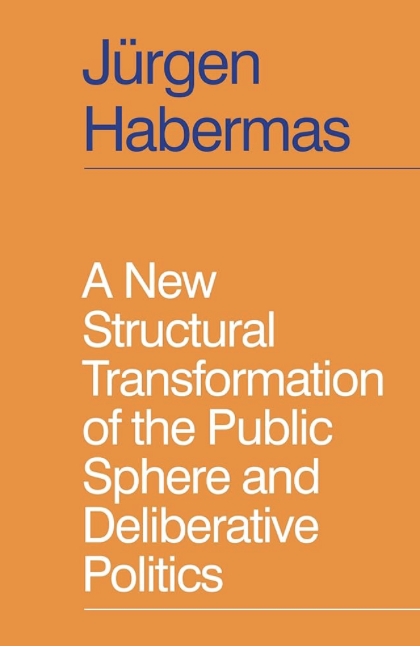
International Journal of Communication Publishes a Book Review Forum on Jürgen Habermas’s A New Structural Transformation of the Public Sphere and Deliberative Politics

International Journal of Communication Publishes a Book Review Forum on Jürgen Habermas’s A New Structural Transformation of the Public Sphere and Deliberative Politics

Jürgen Habermas’s The Structural Transformation of the Public Sphere is a landmark book that continues to have significant influence in communication studies since the publication of the 1989 English edition. It has been a source of inspiration for a rich literature on several topics – public deliberation, communication and citizenship, the role of news institutions in fostering knowledge and critical awareness, the changing forms of publicity and public life, and the impact of capitalist forces on the public sphere. For the past decades, the book has been a mandatory reference and gained canonical status, even if scholars believe that, aside from numerous strengths, the book has important limitations.

Therefore, it is not surprising that the 2023 publication of Habermas’s A New Structural Transformation of the Public Sphere and Deliberative Politics would garner significant interest. The book tackles several subjects at the center of contemporary communication studies, such as digital media/capitalism, rationality/emotion, gatekeeping, deliberation, and counter-publics. Habermas discusses these topics in relation to the long crisis of liberal democracy and the looming presence of anti-democratic threats.

It is fitting for the International Journal of Communication to host a forum on this book. Given the wide uses of Habermas’s work, we believe it would be pertinent to bring together different perspectives. We invited Sarah J. Jackson, Ya-Wen Lei, Barbara Pfetsch, Jefferson Pooley, Sue Curry Jansen, Andrea Wenzel, and Sandra Ball-Rokeach to offer their thoughts on A New Structural Transformation. As we hoped, their contributions are superb—critical, incisive, and comprehensive. Reading the reviews, I am reminded of the value of thinking ambitiously about core questions in communication studies. In a way, Habermas’ work continues to serve as a gathering place where scholars with different research foci meet to engage with shared questions and concerns. We hope that the forum sparks interest in the book, and ideas about critical issues in our beleaguered times.

We invite you to read these articles that published in the International Journal of Communication on October 17, 2024. Please log into ijoc.org to read the papers of interest. We look forward to your feedback!  

Silvio Waisbord
Editor

_______________________________________________________________________

A New Transformation of the Public Sphere? Questions on Identity, Power, and Affect
Sarah J. Jackson

The Decay of the Public Sphere and the Crisis of Liberal Democracy
Ya-Wen Lei

The Decline of Deliberative Democracy in the Age of Digital Capitalism: Revisiting Habermas’s
New Structural Transformation of the Public Sphere
Barbara Pfetsch

Habermas Between Facts and Norms: A Helping of Hope in Dark Times
Jefferson Pooley, Sue Curry Jansen

Can We Revitalize the Public Sphere From the Ground Up?
Andrea D. Wenzel, Sandra J. Ball-Rokeach

_______________________________________________________________________

Silvio Waisbord, Editor 
Kady Bell-Garcia, Managing Editor
Chi Zhang, Managing Editor, Special Sections
Mark Mangoba-Agustin, Webmaster

Please note that according to the latest Google Scholar statistics, IJoC ranks 7th among all Humanities journals and 9th among all Communications journals in the world — demonstrating the viability of open access scholarly publication at the highest level.